A STUDENT GUIDE TO SCIENCE OLYMPIAD
Small structures.
Big questions.
Start here.
The guide I wish I’d had when I started Materials Science. From crystal structures to quantum dots, let’s make the unfamiliar a little easier to understand.
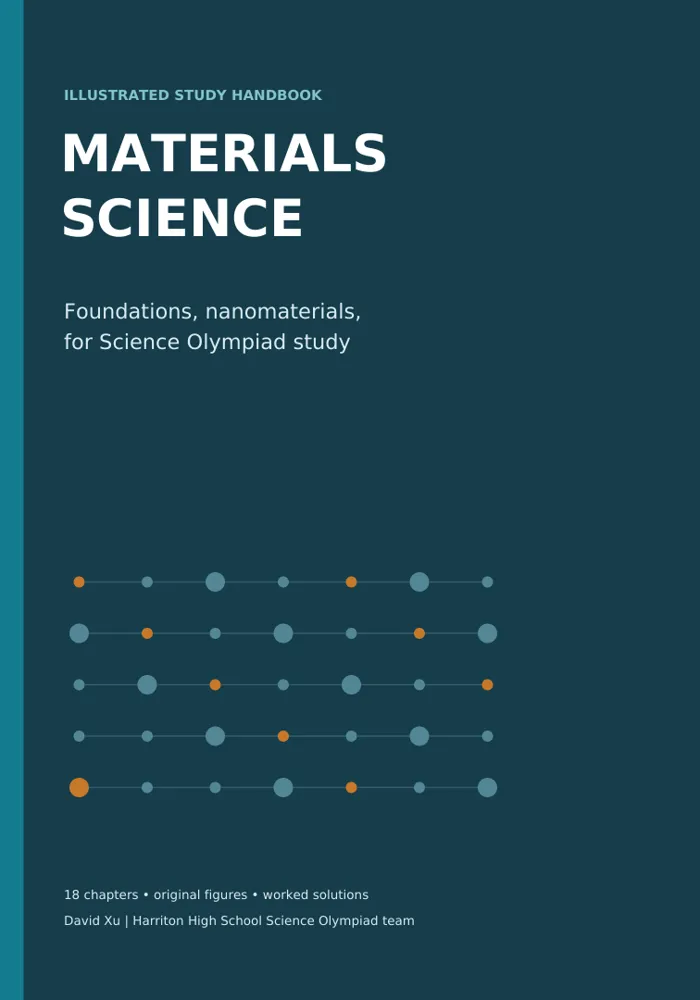 185 pages
18 chapters
Made for the next person starting out.
01 / THE HANDBOOK
A place to begin.
A reason to keep asking.
I made this book to help underclassmen interested in Materials Science prepare for Science Olympiad. It brings the topics together, walks through calculations, and gives the harder questions room to breathe.
The “Q notebook” sections start with questions I needed to research further. They show how to choose a model, check a result, and recognize when an equation needs more information.
02 / FIND YOUR NEXT QUESTION
Choose a starting point.
Read in order or follow your curiosity.
Each topic opens its chapter in the guide.
18 chapters
Reading materials as a chain of causes
Crystal structures and density
Points, directions, planes, and packing
Grains, diffraction, and amorphous solids
Defects and diffusion
Mechanical properties and tests
Strengthening, fracture, fatigue, creep, and wear
Phase stability and transformations
Material families and useful comparisons
Electrical response and semiconductor foundations
Thermal, optical, and magnetic response
Surfaces, wetting, and nanoscale stability
Quantum states and nanoscale transport
Quantum dots and excitons
Carbon and other low-dimensional materials
Synthesis and fabrication
Characterization and evidence
Integrated practice and experimental reasoning
No chapters match that search. Try “surfaces,” “electrical,” or “practice.”
A QUESTION FROM MY NOTES
Same material.
Smaller particle.
What changes?
When a sphere gets smaller, its surface area compared with its volume increases. More of the material is close to an interface—which can change how it reacts, dissolves, or exchanges heat.
Move the radius slider. Surface area grows with r², while volume grows with r³. Their ratio is 3/r.
Read about surfaces in Chapter 12 ↗A geometric comparison. Actual property changes also depend on composition, structure, and environment.
03 / MATERIALS IN PLAIN LANGUAGE
One idea at a time.
Short explainers for curious competitors.
A space to build a monthly writing habit.
FIRST EXPLAINER · OCTOBER 2026 · 3 MIN READ
Why “smaller” can mean a different material.
The surface-to-volume idea behind faster dissolution, reactive powders, and some of the questions that make nanomaterials interesting.
Read the explainer ↗Future topics to explore: why defects can strengthen metals, what a contact angle tells us, and how quantum dots interact with light.
 David Xu · Harriton High School
04 / ABOUT DAVID
From my notes
to your next question.
I’m David Xu, a student at Harriton High School and a member of its Science Olympiad team. I’m interested in materials science and chemical engineering, and I want younger competitors to have a clearer place to start.
Some questions in my notes took more research before I could make sense of them. I kept those questions because the missing step is often the part another student needs explained, too. I want this site to give you a place to start and somewhere to return when a calculation or idea still feels unclear.
My Science Olympiad background +
Individual results · 2025–2026 season
- 1st place, Materials Science — UPenn Invitational
- 2nd place, Materials Science — regionals
- Materials Science medalist — states and Princeton Invitational
- Chemistry Lab medalist — nationals; 2nd place at states
Harriton team results
- 2nd overall at nationals — 2024–2025 season
- 5th overall at nationals — 2025–2026 season
- 1st overall at states and regionals — both seasons
FROM THE NOTES TO THE LAB
There’s a person
behind the page.
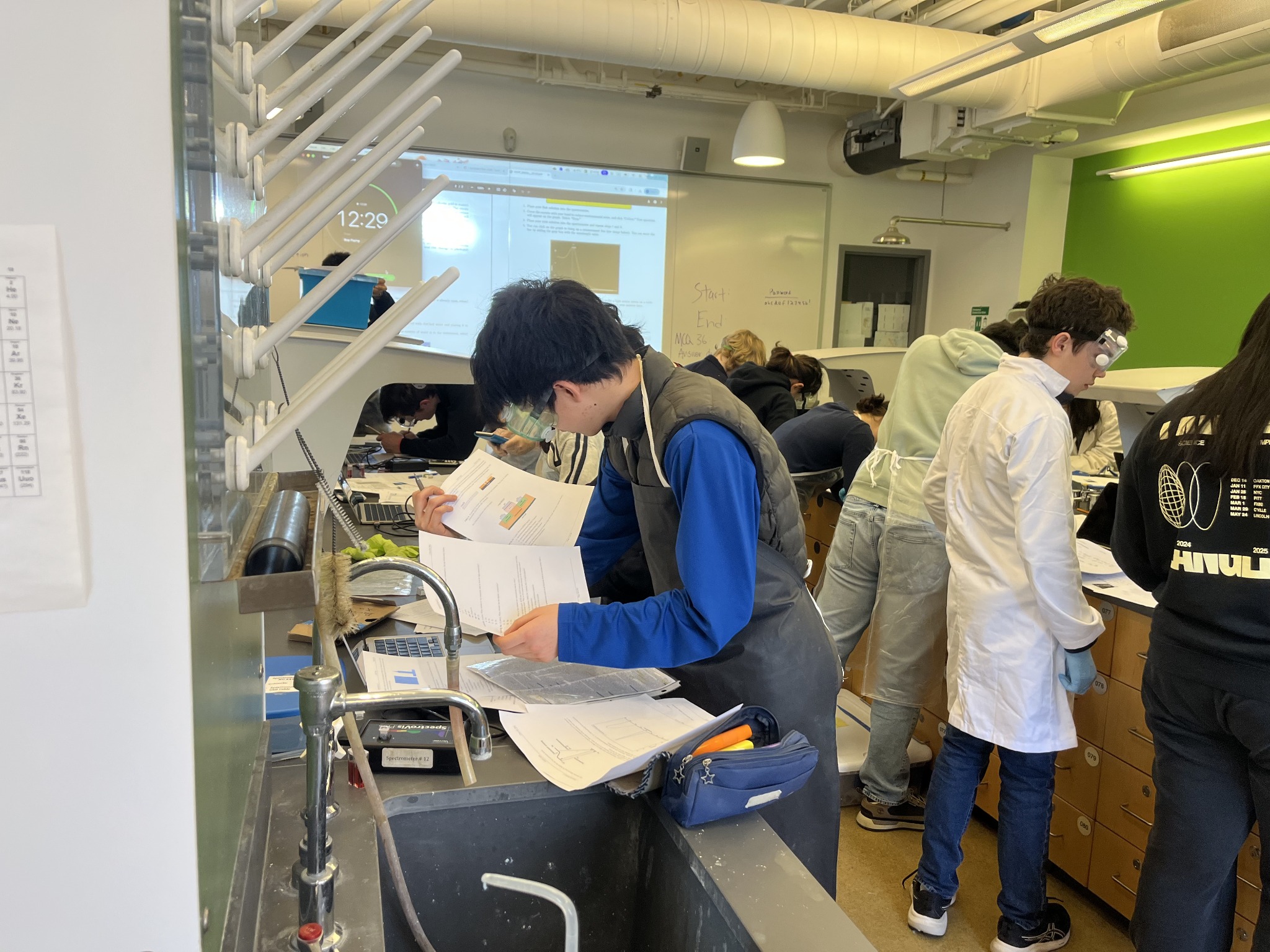
This is me doing lab work at the UPenn Invitational. The handbook brings together my preparation notes and the questions I wanted to understand better. This photo is a small part of the competition experience behind the project.
I hope the guide helps you feel ready to work through unfamiliar questions of your own.
05 / MY PREPARATION NOTES
Open the notebook.
The notes behind the handbook,
shared in their working form.
These documents are my working notes, not a second finished textbook. Read them alongside the handbook, and check a reference if a shortcut or an unfinished explanation raises a question.
Mat Sci ↗
My chapter notes and questions I researched further.
CONDENSED REFERENCENats Matsci CS ↗
A compact reference sheet from my competition preparation.
QUESTIONS & EXPLANATIONSNats Q ↗
Additional questions and explanations to work through.
SURFACES & INTERFACESSurface Chem ↗
Notes on surface tension, wetting, adhesion, and wear.
A BOOK I RECOMMEND
Materials Science and Engineering: An Introduction
William D. Callister Jr. and David G. Rethwisch · ninth and tenth editions
I recommend Callister and Rethwisch as a starting point for crystal structures, mechanical properties, phase diagrams, and physical properties. The explanations and worked examples are useful alongside this guide. The two editions overlap substantially; you do not need both to get started.
Look for a library copy or an authorized edition. The textbook PDFs are not hosted here.
06 / QUESTIONS & CORRECTIONS
What are you
working through?
If something in the guide is unclear, or you notice a mistake, email me. Include the chapter or page number and the step you’re unsure about so I can understand the question.
davidxu.materials@gmail.com ↗For handbook feedback, materials questions, and study-resource suggestions.
YOUR NEXT STEP